Wyoming Asset Protection Trust Cost: What It Costs & Works

If you're weighing a Wyoming asset protection trust, you probably want one answer first: what does it cost? We'll give it to you straight. There's no single price, but there are clear cost lines, and we'll walk through each one, then the setup steps and where a trust falls short.
Key takeaways
- No fixed price fits every family: attorney drafting is usually the largest setup cost, and trustee fees are often the largest yearly one.
- A trust protects only what has been moved into its name, and a transfer made to dodge a claim already in view can be unwound.
- An LLC generally limits a creditor to a charging order, while a trust means giving up direct control, so many owners use both.
How a Wyoming asset protection trust works and what it can't do
A Wyoming domestic asset protection trust (DAPT) is generally an irrevocable trust, run by a Wyoming trustee, and meant to help shield the assets inside it from future claims. You transfer assets to the trust, the trustee holds and manages them, and a creditor has a harder time reaching them than if you owned them outright.
Wyoming appeals to many owners for two reasons. The state has no income tax, though federal tax still applies, and the trust document isn't filed on the public record.
The limits matter just as much. A trust generally won't stop debts you already owe, and you give up direct control of whatever you put in.
No state is automatically the best choice for everyone, and Wyoming is one strong option among several, so it's worth comparing states where you can keep your name private before you commit.
What a Wyoming asset protection trust costs
No fixed price fits every family, because each cost line grows with the size of your estate and how complicated your assets are. So instead of quoting figures, we'll explain what each line pays for, which is what you need to judge any quote you're handed.
What drives the setup cost
Attorney drafting is usually the largest setup line. You're paying a Wyoming attorney to write a document that fits your assets and your family, and that's the wrong place to cut corners.
Next comes trustee or trust company setup, which covers onboarding with a Wyoming trustee, whether that's an individual resident or a Wyoming trust company.
Funding adds its own costs. Moving real estate into the trust, for example, means county deed recording fees. The trust itself usually needs no state filing, but any LLC in your plan does, so add that to the list.
Ongoing yearly costs to budget for
Trustee fees are often the largest recurring line, because the trustee carries real legal responsibility for what the trust holds. Tax filings, where required, come on top, along with record-keeping to show the trust is run as the document says.
Plan on a periodic attorney review too, since laws and family circumstances change. Ask every provider what's included in their annual fee before you sign, because the answer differs more than you'd expect.
How to set up a trust in Wyoming, step by step
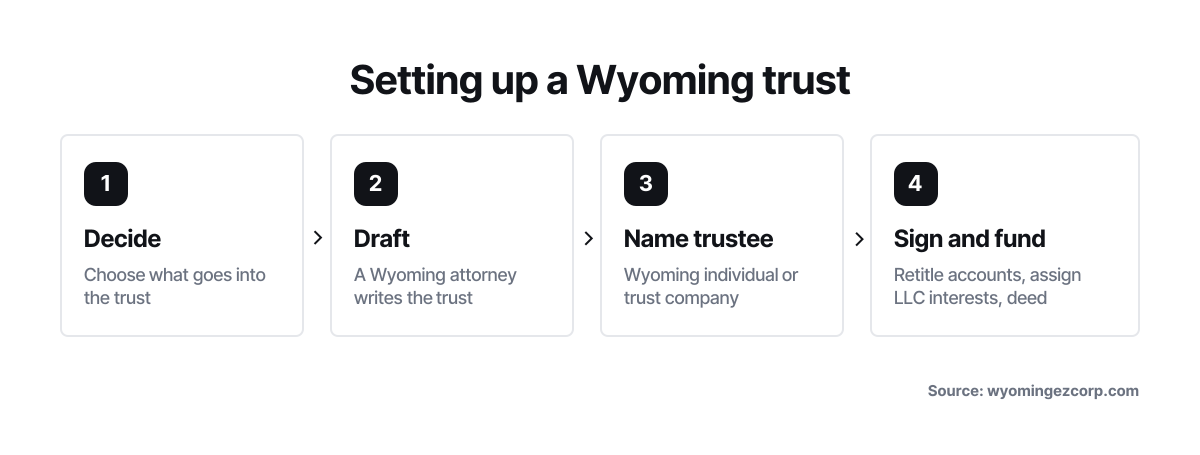
The order matters more than the speed. Here's the sequence most people follow:
- Decide what goes in: accounts, property, LLC interests or a mix.
- Have a Wyoming attorney draft the trust.
- Name a Wyoming trustee, either a Wyoming-resident individual or a Wyoming trust company.
- Sign the trust and fund it.
This is general information, not legal or tax advice. When you're ready to look at the options, our trust services are the place to start.
Funding the trust is the step people skip
A trust protects only what has been moved into its name.
That means retitling accounts, assigning LLC interests and deeding property. A signed trust with nothing in it protects nothing, and plenty of people stop after the signing.
Timing counts as well. A transfer made to dodge a claim already in view can be unwound, so fund the trust before trouble shows up, not after.
EZ Corp Services is trusted by more than 150 attorneys and professionals, which is why we keep the trust drafting with a Wyoming attorney, where it belongs.
Asset protection trust vs. LLC: how they differ and when to use both
An LLC is the lighter tool. It generally limits a creditor to a charging order on distributions, you keep direct control as the manager, and the paperwork is modest. You can see what a Wyoming LLC costs to form and keep and set it beside the trust lines above.
A trust asks more of you. You give up direct control, you pay trustee fees, and you accept ongoing administration in return for protection aimed at assets you plan to hold for the long haul. On privacy, the trust document isn't filed publicly, and our guide to keeping your LLC name off the public record covers the LLC side.
Neither one fixes everything. A trust isn't for you if you need to keep full, hands-on control of every asset, and an LLC alone won't separate your operating business from your longer-term family wealth.
That's why many owners use both. In a typical case, a business owner forms a Wyoming LLC to run the company, then later moves the membership interest into a trust, so the operating business and family assets are planned separately. Your attorney confirms the structure.
If you'd like to talk the LLC and privacy side through, call us at EZ Corp Services. You'll reach a real person on the phone, not a call center, and we'll point you to the right next step for the trust.
Frequently asked questions
How much should an asset protection trust cost?
There's no single number, because the total depends on your assets and how complex they are. Budget for attorney drafting, trustee setup and funding costs up front, then trustee fees, any tax filings and periodic attorney review each year.
What are the disadvantages of an asset protection trust?
You give up direct control of what you put in, and the trust generally won't protect against debts you already owe. It also needs ongoing administration, which means yearly costs.
What state has the best trust for asset protection?
No state is automatically best for everyone. Wyoming is a common choice because it has no state income tax and no public filing of the trust document, but it's one strong option among several.